Thursday, January 20, 2022
Chain Link
Chain Link is made from Kaffe Fassett stripes and Yoshiko Jisenji fabric. I was sorting my fabric stash and decided to use fabrics that made me happy and these two designers just stood out. I saw the pattern for this quilt from the 2020 Tokyo Quilt Show. Of course I didn't attend, but saw the photo from a blogger who did. The quilt was an embroidered crazy quilt made by Matsuko Sugi. Her fantastic quilt was hand embroidered with a beautiful selection of what I think are japanese silks. I named it chain link, but I'm not sure if that is the correct name of this pattern, because I haven't seen it in a book. It is a challenging piece to put together, but if you use beautiful fabric you'll be challenged to finish it.
Hoku Anuenue or Rainbow Stars
The Hoffman 1895 Watercolor panel was the inspiration for Hoku Anuenue or Rainbow Stars. I had received the panel as a gift from Betsy and I wondered how I was going to use the colors on the panel. I didn't have a clue and just started cutting out the small diamond shapes. I finally made my own pattern of 5 pointed stars and used the panel color chart to mimic the layout of the colors. The stars are hand pieced and the borders are machine pieced using the leftover diamond shapes. It is machine quilted.
Saturday, January 30, 2021
Kaffe Fassett #1
This is the first Kaffe Fassett quilt that I made with the cut up scraps. Can you see the major design flaw? I keep telling myself that it doesn't bother me, but it does. Somewhere I got lost and couldn't figure out how to place the red and the blue fabrics. So I convinced myself that it didn't matter and to keep going. This is what happens when you don't have a big design board.
The crysanthemum, guinea flowers and big blooms are so pretty.
I started from the outer edges and worked my way in alternating with red and blue fabric.
This is the first quilt that I used this technique, so I have learned to pay attention. I should have stopped and taken it all apart until it looked right.
The crysanthemum, guinea flowers and big blooms are so pretty.
I started from the outer edges and worked my way in alternating with red and blue fabric.
This is the first quilt that I used this technique, so I have learned to pay attention. I should have stopped and taken it all apart until it looked right.
Kaffe Fasset #3
This is the third quilt made from the Kaffe Fassett and KF Collective fabrics that I cut up into usable scraps. I wanted to use a fabric that made me smile and the KF fabrics have always made me happy.
The fabrics were all cut into 6 inch squares and then sorted by color.
It was more interesting to put the squares on point and then go round and round with 10 squares on each side. I used my bed as my design board and put a sheet on it. Still it was hard to fit all the squares onto the sheet and I had to pin some down. Once the pattern looked pleasing enough, I sewed them together.
Some of the fabrics are really old and some I'm not sure if they were KF but if it looked like it, I used them.
The fabrics were all cut into 6 inch squares and then sorted by color.
It was more interesting to put the squares on point and then go round and round with 10 squares on each side. I used my bed as my design board and put a sheet on it. Still it was hard to fit all the squares onto the sheet and I had to pin some down. Once the pattern looked pleasing enough, I sewed them together.
Some of the fabrics are really old and some I'm not sure if they were KF but if it looked like it, I used them.
My friend Lily was able to fix my laptop, so I am able to write on this blog. Thank you Lily, it took a long time but it was worth it. I'll have to catch up for the whole year that I didn't post. Please bear with me.
Friday, July 5, 2019
Twinkle
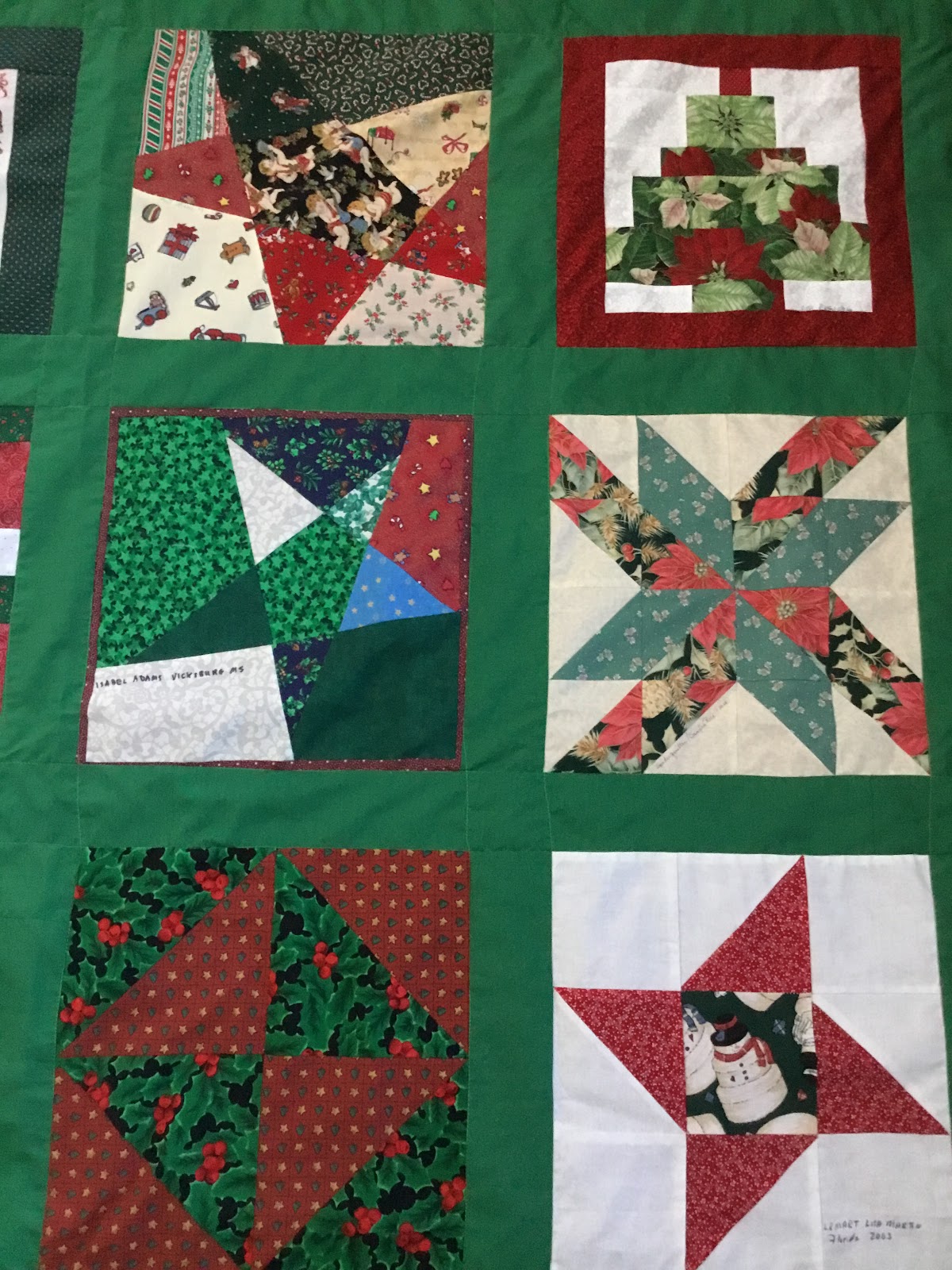
This is a quilt that I finished for the Moilili Senior Community Center. Twinkle had donated the blocks made from the HGTV show sometime in 2003. It was a block swap, so the blocks were from all over the country and had the makers name and city on them in ink. What a fun swap. As you can see some of the blocks are complicated, and I'm sure they took a lot of time to make.
Luckily, I had some bright green solid fabric and a nice hawaiian red print fabric for the backing in my stash. It was perfect to simply highlight the blocks with the green fabric and use the red fabric for the binding.
I called Twinkle to ask permission to use the photos on my blog. Thank you Twinkle for donating the blocks. The ladies at Moilili were oohhing and aahhhing the quilt when I brought it to them. She said that they were going to put it in their annual Temari Trash to Treasures sale in November and put a price of $100.
That is a bargain. They asked me how long it took me to put the quilt together and I said 20 hours. I think they record how many volunteer hours are used. Now I have to fill out a form to say that I am a volunteer. Well, it keeps me busy. I have asked my mom Sue, aunty Shinno, Carol and Lea to help me. The ladies from Moilili have given me 3 more tops to complete, so I need to share the wealth with my Ohana.
Luckily, I had some bright green solid fabric and a nice hawaiian red print fabric for the backing in my stash. It was perfect to simply highlight the blocks with the green fabric and use the red fabric for the binding.
I called Twinkle to ask permission to use the photos on my blog. Thank you Twinkle for donating the blocks. The ladies at Moilili were oohhing and aahhhing the quilt when I brought it to them. She said that they were going to put it in their annual Temari Trash to Treasures sale in November and put a price of $100.
That is a bargain. They asked me how long it took me to put the quilt together and I said 20 hours. I think they record how many volunteer hours are used. Now I have to fill out a form to say that I am a volunteer. Well, it keeps me busy. I have asked my mom Sue, aunty Shinno, Carol and Lea to help me. The ladies from Moilili have given me 3 more tops to complete, so I need to share the wealth with my Ohana.
Thursday, February 14, 2019
Japanese Fabric
I decided to start cutting my Japanese fabric and make some queen size tops for donation. This is the first one that I made. It is cuts of 9 inch fabrics sewn together. There are 10 across and 10 down for a total of 100 stash busting fabrics.
The fabrics are pretty, but this layout does not enhance the design or the fabric. The size is 85 x 85 and was donated to EBHQ quilts.
This layout is a little bit better. It is the same 100 assorted japanese fabrics. This time the fabrics were matched with dark and light. Then a diagonal line was drawn and 1/4 inch sewn on either side of the diagonal. This gave me 2 half square fabrics. Put together in this placement is much more pleasing.
Here is a closeup photo. From far away you can clearly see the dark and lights. Up close it is not as easy. This was donated to EBHQ and came out to 83 x 84.
This is the same assortment of 100 fabrics of japanese fabrics. I like this design much better. I sorted out about 20 dark fabrics and cut the 9 inch fabrics into 4 to make 2.25 x 9 inch cuts. I placed 64 fabrics on the design wall sorting them by color. I also cut about 81 brights of 2.25 x 2.25 for the cornerstones from the scraps.
This took a little longer to piece and arrange but it shows off the fabrics much better when it is surrounded by a dark fabric. I've shown this to family and friends and they all want this one to be made up. Well, I do have more japanese fabrics that I haven't cut up yet. I have to find the backing, but I won't donate this to EBHQ.
The fabrics are pretty, but this layout does not enhance the design or the fabric. The size is 85 x 85 and was donated to EBHQ quilts.
This layout is a little bit better. It is the same 100 assorted japanese fabrics. This time the fabrics were matched with dark and light. Then a diagonal line was drawn and 1/4 inch sewn on either side of the diagonal. This gave me 2 half square fabrics. Put together in this placement is much more pleasing.
Here is a closeup photo. From far away you can clearly see the dark and lights. Up close it is not as easy. This was donated to EBHQ and came out to 83 x 84.
This is the same assortment of 100 fabrics of japanese fabrics. I like this design much better. I sorted out about 20 dark fabrics and cut the 9 inch fabrics into 4 to make 2.25 x 9 inch cuts. I placed 64 fabrics on the design wall sorting them by color. I also cut about 81 brights of 2.25 x 2.25 for the cornerstones from the scraps.
This took a little longer to piece and arrange but it shows off the fabrics much better when it is surrounded by a dark fabric. I've shown this to family and friends and they all want this one to be made up. Well, I do have more japanese fabrics that I haven't cut up yet. I have to find the backing, but I won't donate this to EBHQ.
Friday, December 21, 2018
It started as White - 2
This is another quilt that I made of my hand dyed stash. Sorry the picture is missing the fabrics on the two sides. The center squares were made with Sujatas technique of freehand cutting. The dyed fabrics have retained their bright colors.
I wish I could remember how I made that green batik. I know that I had a lot of fun making these. It helped that the classes had everything prepared and all the dyes and materials there for you to use.
This is the backing fabric of a cotton childrens yukata. I think I bought the fabric at a craft fair at the JCC in Hawaii for $25. Its getting harder to find this type of fabric for a reasonable price. I quilted the quilt from the back and followed the outline of the flowers and leaves. It was a very nice quilting pattern since it started on one end to the other.
I wish I could remember how I made that green batik. I know that I had a lot of fun making these. It helped that the classes had everything prepared and all the dyes and materials there for you to use.
This is the backing fabric of a cotton childrens yukata. I think I bought the fabric at a craft fair at the JCC in Hawaii for $25. Its getting harder to find this type of fabric for a reasonable price. I quilted the quilt from the back and followed the outline of the flowers and leaves. It was a very nice quilting pattern since it started on one end to the other.
It started as White
What do you do with all those beautify hand dyed fabric that you have on your fabric shelves. All of these fabrics started out as white and were dyed in different classes. I think they came from classes I took with Ellen Oppenheimer, Lynn Koolish, Jan Meyers Newbery. I did not take enough notes during those classes. I recognize batik, low emersion dying, acid dyes, procion dyes, stamping, shibori, ???
Do you see the blue shark? There is a turtle in the design of the shark. The brown fabric uses wooden chops dipped in wax.
This is a backing of cotton yukata of yellow butterflies.
I quilted the butterflies from the back. This is how the quilting looks from the front. Overall, I am very happy to finally use some of these precious fabrics.
Nani Iro
This quilt was made from fabric remnants that I purchased at Kaimuki Dry Goods. I think there were 4 remnant packets. The packets were different sizes 9x18, 18x22, 9x44 and different prices between 7 to 10 dollars. Sorry, the picture does not include the whole quilt. There is another border of red and cream on the right side that couldn't fit in.

The middle fabrics of yellow purple blue and aqua did not have the designer name or fabric line. It is actually bubbles that look like they were made by a shibori technique of tying pebbles in fabric before dyeing the fabric. The fabric retained the shibori crinkly effect.
The surrounding fabric named the designer as Naomi Ito from the fabric line by Nani Iro. At first I thought it was the same person because the names were so similar. The fabric was very soft and I think it is considered a cotton gauze. They printed the Made in Japan so far into the selvage that it was a waste not to use it. I used the improv techniques I learned from Sujata Shah to make the hourglass and triangles.
This is the backing fabric of a woven stripe. I really liked the way the weave of the purple and gold looks. You can see how I quilted around the bubbles in the middle motif. The triangles and surrounding strips were just quilted in the ditch. I think the size came out to about 50 x 60.
Wednesday, September 26, 2018
Blues
This is a 75 x 75 bed quilt made with a roll of 40 Kona cotton blue 2.5 strips and blue and white scraps that I have been saving for a long time. I found the roll of strips at Calico Cat quilt shop in Kaimuki. The strips were sewn end to end starting from the Darks to the lights. The scraps were cut into 4.5 x 8. They were sorted by lights to dark. 10 lights at the top down to 10 rows with a total of 100 scraps with the darks on the bottom.
The dark strips were paired with the lightest scraps. The lightest strips were paired with the darkest scraps. The block is a simple pattern with the strips sewn on both sides. Then the blocks were placed verticle to horizontal. I have seen this pattern in older quilts and it is a very pleasing. Some quilts have put borders around the blocks, but this one has no border. I did have to buy 1 yard of the light blue fabric to complete the last blocks. I think I bought enough to make the binding. Since this was made for Hawaii, I did not put in a batting. The backing fabric is a japanese blue with white dots. The quilting was done stitch in a ditch with dark blue aurifil thread. Most of the scraps were cut from a pack of fat quarters of Indigo. There are also some kasuri, woven ikat, batik and boro scraps. This was given to my Dad.
Friday, August 3, 2018
Woven 28
This is a picture of woven 28. It is made with Kaffe Fassett shot cottons from strips of 2.5 inches in 28 different colors. I think the size was about 56 x 56.
The interplay of colors are wonderful. The back is from kimono fabric. It was a blue and white summer yukata fabric. I bought the kimono from the Moilili Bon dance last year for $15. There were old spots that were little brown dots here and there. I undid the hand sewn stitches and washed the fabric in oxyclean. There was just enough to make a nice backing. The cotton fabric is so nice and soft. The batting is a 80 % cotton poly bled.
I think my Mom gave this quilt to her friend Sumiko. She is a new grandmother.
The interplay of colors are wonderful. The back is from kimono fabric. It was a blue and white summer yukata fabric. I bought the kimono from the Moilili Bon dance last year for $15. There were old spots that were little brown dots here and there. I undid the hand sewn stitches and washed the fabric in oxyclean. There was just enough to make a nice backing. The cotton fabric is so nice and soft. The batting is a 80 % cotton poly bled.
Monday, July 9, 2018
Cotton and Steele
This quilt was made with leftover scraps of Cotton and Steele that I purchased from the PIQF show in 2017. The scraps were sewn into strips to make blocks of 10.5 inches.
They were then alternated horizontal or vertical. I think the dimensions were 60 x 70. The fabrics were very colorful and playful. Although there were some halloween fabric that had cute skulls and ghosts.
The quilting was done from the back with Aurifil 50 wt thread. I followed the outline of the flowers with free motion quilting.
This is the Kaffe Fassett fabric that I used for the back. It makes such a pretty bright back. This was given to my Aunty Helen on my Moms side, who is 90 years old. She needed a twin size quilt for her bed. I had given her a queen size quilt earlier, but she said it was too big. This was given to her daughter Charlene who just recently retired.
Monday, February 19, 2018
Skyscrapers
This is my latest quilt. It was made from four panels of the Hoffman watercolor fabric. I did not count the total number of swatches, but they were 1 inch by 2 inch pieces of the watercolor palette. The size was enough to make either a thimble or half a hexagon. Two panels were used to make the hexagons and two panels were used in the thimbles.
I tried to keep the thimbles sorted. I added one row of Hoffman fabric and three rows of scrap thimbles. It was hard to find the right colors in the scraps.
I did not plan the border very well. The top and bottom border were originally one piece. I had to stretch the hexagons out by separating the two hexagons to have enough for the top and bottom border. The white fabric came from scraps of white on white and the leftovers from the Hoffman panels.
This was made over a two year time. I would start it and then put it away. The hexagons were hand pieced. The thimbles were machine pieced. The quilting is stitch in a ditch.

I tried to keep the thimbles sorted. I added one row of Hoffman fabric and three rows of scrap thimbles. It was hard to find the right colors in the scraps.
This was made over a two year time. I would start it and then put it away. The hexagons were hand pieced. The thimbles were machine pieced. The quilting is stitch in a ditch.
Saturday, December 23, 2017
Triangles
This is a triangle quilt using scraps that I have saved from bindings and scraps. It was so satisfying to use them. I started with an equilateral triangle and then added the scraps to two sides of the triangle.
Tuesday, August 8, 2017
Polyester is not so bad
The blue throw is actually a remnant piece of wool that I just edged and included because it matched so well with the polyester.
The fabrics came from this pile of polyester fabrics that have been stored since the time Mom worked at Danneman's when we lived in Delaware from 1970 to 1974. Danneman's was a fabric store in the Blue Hen Mall. Mom told me the story of how she decided to go to work when the kids (me) started high school and she had the free time. She had taken business classes after high school and Dannemans was the first store that she went to apply for a job. I asked if she got an employee discount because I noticed some fabrics had an extra discount taken off. She said that there was no such thing as employee discounts and she usually bought fabrics when the remnants were on sale.
This is a bag the fabric was stored in. At first I was just going to throw all the polyester fabric away. But since making these pillows, I am going to put it back in the closet and see if there are other projects that I can use these.
Subscribe to:
Posts (Atom)